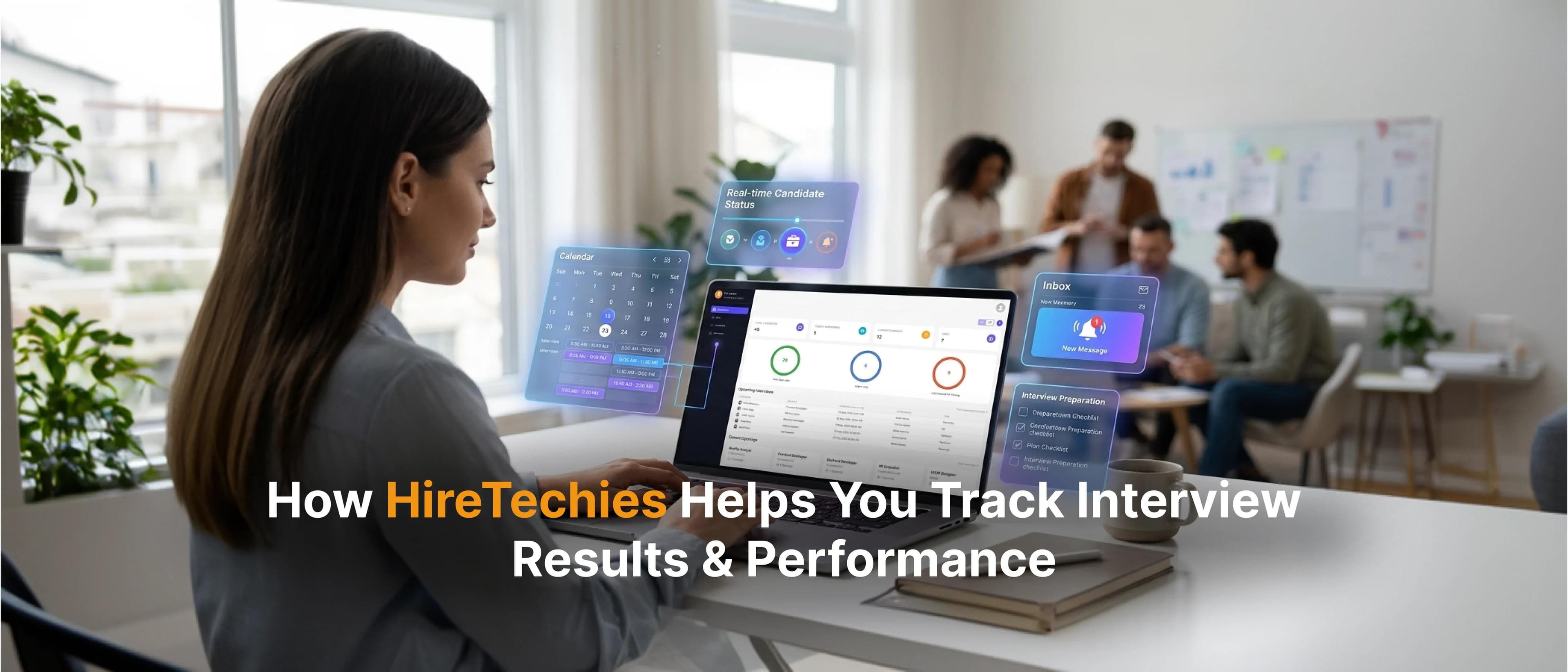
How HireTechies Helps You Track Interview Results & Performance
RecruitmentMost hiring teams make the same mistake. They spend weeks interviewing candidates, collecting feedback in scattered emails and spreadsheets, and then wonder why the final decision still feels like a guess.
The problem is rarely the interviews themselves. It is the lack of a clear system to track what happened in each one and what it actually means.
Why Interview Tracking Gets Ignored Until It Becomes a Problem
Hiring feels urgent. There is always a role to fill, a deadline to meet, a manager pressing for someone to start. In that pressure, documentation and performance tracking get pushed to the side. Someone will do it later. Later never really comes.
Then the wrong person gets hired. Or the right person gets missed because nobody can remember clearly how their second interview went compared to three other candidates. These are not rare outcomes. They happen constantly in companies of every size.
A lot of businesses treat interview tracking as an administrative task rather than a strategic one. That is the mindset that creates the problem.
What Tracking Interview Performance Actually Means
Before getting into how this works in practice, it helps to be clear about what interview performance tracking actually involves. It is not just logging that an interview happened on a certain date.
Real tracking means recording how each candidate performed across specific competencies, how different interviewers rated them, where there were disagreements between evaluators, and how candidates in earlier stages compared to those who made it further. When you have this data properly organised, patterns emerge that you simply cannot see when everything is scattered.
For example, if your team consistently disagrees on the technical assessment stage but aligns closely on culture fit, that tells you something important about how your interview process is structured. You can only see that if the data is in one place and organised in a way that makes comparison possible.
How HireTechies Approaches This Differently
HireTechies is built around the idea that the interview process should produce usable intelligence, not just a hire or no-hire decision at the end.
When a candidate moves through stages on the platform, every interaction is logged in a structured way. Interviewers submit feedback through a consistent format rather than free-form notes that vary wildly depending on who is writing them. This consistency is actually more important than most people realise. When one interviewer writes two sentences, and another writes two paragraphs in completely different formats, comparing their assessments meaningfully becomes nearly impossible.
The platform standardises this without removing the ability for interviewers to add context and nuance. Ratings against predefined competencies sit alongside open comments. Both pieces matter, and having both in the same place for every candidate changes how clearly you can see what happened.
Seeing Patterns Across Your Entire Hiring Pipeline
This is where the real value shows up. Individual candidate tracking is useful. Pipeline-level tracking is what actually improves your hiring process over time.
When you can see that candidates who pass your first technical screen at a high rating consistently struggle in the final stage, that is a signal worth investigating. Either the first screen is too easy, the final stage is testing something different than expected, or there is a gap in how your team is evaluating people at different points.
Most hiring teams never see this because they are looking at one candidate at a time rather than the pipeline as a whole. The data exists in their process, but it is never aggregated in a way that reveals these patterns.
With a structured tracking system, this kind of analysis becomes straightforward rather than requiring someone to manually compile information from multiple sources just to ask a basic question about how the process is performing.
How Interviewer Calibration Becomes Possible
Here is something that almost nobody talks about openly. Different interviewers within the same company evaluate candidates very differently, even when they are supposedly assessing the same things.
One interviewer consistently rates technical candidates higher than their peers. Another rarely gives top marks to anyone. A third focuses heavily on communication skills in a role where they are only moderately important. These biases are not intentional, but they are real, and they skew hiring decisions in ways that are invisible when feedback is collected informally.
When interview results are tracked systematically, interviewer calibration becomes possible. You can see over time how each interviewer rates relative to others and identify where significant divergence exists. This is not about criticising individual interviewers. It is about creating a shared standard so that a high rating from one person means roughly the same thing as a high rating from another.
Companies that do this well end up with more consistent hiring decisions and fewer situations where a candidate's outcome depends more on who interviewed them than on how they actually performed.
Tracking Across Roles and Over Time
Single role tracking is useful. Multi-role historical tracking is genuinely powerful. When you can look back across twelve months of hiring data and see which sourcing channels produced candidates who performed best in interviews, or which job descriptions attracted applicants who consistently dropped off at a specific stage, you have information that directly improves how you hire next time.
This is the level of insight that larger companies with dedicated recruiting operations teams work hard to build. A well-structured platform makes it accessible without needing a team of analysts to extract and interpret the data manually.
What Good Data Makes Possible That Bad Data Does Not
A hiring decision made with clear, structured data behind it looks very different from one made on gut feeling and scattered notes. Neither approach guarantees the right outcome. Hiring will always involve some uncertainty. But the quality of the decision-making process itself improves substantially when the information is organised and visible.
Teams using structured interview tracking tend to make faster decisions because they spend less time trying to reconstruct what happened in earlier stages. They have fewer internal disagreements about candidates because the evaluation criteria were clear from the start. And over time, they build a genuinely useful record of what good performance in their interview process looks like.
The Closing Thought
Hiring is one of the most consequential things a company does. The data that comes out of your interview process is valuable. Whether it actually gets used depends entirely on whether it is being captured in a way that makes it usable.
That gap between data existing somewhere and data being organised and visible is where most interview tracking falls apart. Closing that gap is what the right tools make possible.