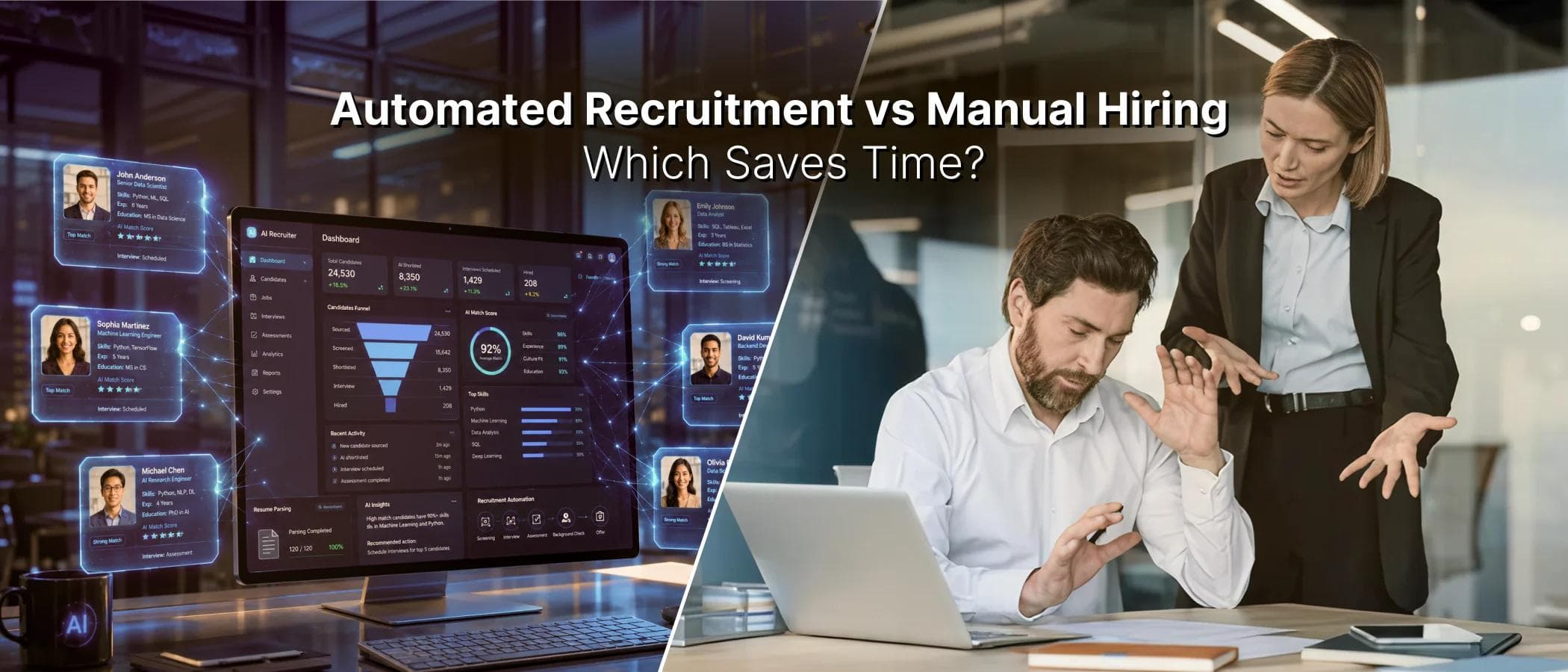
Manual Hiring vs Automated Recruitment: Which Saves Time?
Two recruiters, same job opening, same candidate pool. One is buried in spreadsheets, manually shortlisting resumes and typing out interview emails one by one. The other clicks a button, lets software rank candidates by fit, and has interviews scheduled before lunch. Same job. Same deadline. Completely different outcome.
This is the real difference between manual hiring and automated recruitment, and it's why more companies are switching to tools like free AI Applicant Tracking Software to close roles faster without adding headcount
What Is Manual Hiring?
Manual hiring is the traditional way of recruiting. It usually means managing job applications in Excel sheets, screening resumes by eye, and coordinating interviews through email chains.
Most small teams and early-stage startups start here because it feels simple. New tool to learn, no setup, just a shared spreadsheet and a Gmail inbox. The problem shows up as the number of applications grows. A recruiter screening 100 resumes manually might spend an entire day just shortlisting, before a single interview is even scheduled.
Manual hiring also depends heavily on memory and manual updates. If someone forgets to move a candidate to the next stage, that person might sit in the pipeline for days without anyone noticing.
What Is Automated Recruitment?
Automated recruitment uses software to handle the repetitive, time-consuming parts of hiring. Think resume screening, candidate ranking, interview scheduling, and follow-up emails.
Instead of a recruiter reading every resume line by line, an AI-powered ATS scans applications against the job requirements and highlights the candidates worth a closer look.
This doesn't mean recruiters step back from decision-making. It means they stop spending hours on tasks a system can do in seconds, and spend that time on interviews and judgment calls that actually need a human.
Tools like HireTechies are built around this idea: automate the routine, keep humans in charge of the important calls.
Manual Hiring vs Automated Recruitment:
When comparing manual hiring with automated recruitment, the difference becomes clear in everyday recruitment tasks. Manual hiring requires recruiters to review resumes one by one, manage candidate details in spreadsheets, schedule interviews through multiple emails, and send follow-up messages manually. These tasks are time-consuming and become harder to manage as the number of applicants grows.
Automated recruitment simplifies the entire process. AI can screen and rank resumes within minutes, while a centralised dashboard keeps all candidate information in one place. Interview scheduling, candidate communication, and reminders are automated, reducing manual work. Recruiters also get real-time reports and can collaborate with their team more efficiently. As a result, hiring becomes faster, more accurate, and easier to scale without increasing workload or costs.
Where Recruiters Lose the Most Time in Manual Hiring
If you've ever tracked your own week as a recruiter, you'll notice the time doesn't go where you'd expect.
Resume screening eats the biggest chunk. Sorting through hundreds of applications for one role, especially in IT hiring where technical skills need careful matching, takes hours that rarely feel productive.
Email follow-ups are the second time sink. Reminding candidates about interview slots, chasing hiring managers for feedback, and sending status updates all add up across a busy week.
Scheduling interviews sounds small, but it rarely is. Coordinating calendars between candidates and multiple interviewers usually means five or six emails just to lock one time slot.
Candidate tracking in spreadsheets gets messy fast. Duplicate entries, outdated stages, and missing notes are common once you're managing more than a handful of open roles.
Reporting at the end of the month often means manually pulling numbers together for leadership, which is tedious and prone to errors.
Team coordination adds another layer. Without a shared system, hiring managers and recruiters end up repeating information over email or Slack instead of working from one source of truth.
None of these tasks is difficult on its own. But together, they quietly consume the hours recruiters could spend on sourcing, interviewing, and closing candidates.
How Recruitment Automation Saves Hours Every Week
This is where a Free AI Applicant Tracking Software changes the math for hiring teams.
AI resume screening scans every application against the job description and flags the strongest matches instantly, instead of a recruiter reading each one manually.
Candidate ranking takes it a step further by scoring applicants based on skills and experience, so recruiters know exactly who to prioritise first.
Interview scheduling becomes automatic with calendar integrations. Candidates pick a slot that works, and the system handles reminders on both sides.
Email automation takes care of routine communication, interview invites, status updates, and rejection notices, without anyone typing the same message twenty times a week.
Hiring pipeline tracking replaces the spreadsheet entirely. Every candidate's stage updates in real time, visible to the whole hiring team at once.
Analytics give recruiters a live view of time-to-hire, source performance, and bottlenecks, without pulling numbers together manually.
Team collaboration improves because everyone works from the same platform. Hiring managers can leave feedback directly instead of forwarding emails back and forth.
Put together, these small savings across the week add up to real hours back for recruiters, hours that go toward better conversations with candidates instead of admin work.
Manual Hiring vs Automated Recruitment: Which Is Better for Growing Businesses?
The right approach often depends on where your business stands.
Startups hiring their first ten employees can usually manage with manual hiring for a while. But the moment hiring becomes a weekly activity instead of an occasional one, automation starts paying off fast.
SMBs typically feel the pain first. They're hiring across multiple departments without a dedicated recruitment team, which makes manual tracking almost impossible to sustain.
Enterprises already run structured hiring processes, but manual coordination across departments and locations still creates delays. Automation here means fewer bottlenecks between HR, hiring managers, and candidates.
IT recruitment is a category of its own. Technical roles need precise skill matching, and manually reading through resumes full of tools, frameworks, and certifications is genuinely time-consuming. AI-based screening handles this far more consistently.
Across all four, the common thread is simple: as hiring volume grows, manual processes stop scaling, and automated recruitment becomes less of an upgrade and more of a necessity.
Signs Your Company Has Outgrown Manual Hiring
A few warning signs usually show up before a company realises it needs a change.
- You're receiving too many resumes to screen manually within a reasonable time.
- Candidates are slipping through the cracks because follow-ups get missed.
- Time-to-hire keeps growing instead of improving.
- Candidates complain about slow communication or unclear next steps.
- Your hiring spreadsheet has become impossible to keep updated.
- Hiring managers and recruiters keep hitting the same bottlenecks every cycle.
If two or three of these sound familiar, that's usually the point where automated recruitment starts making sense, not as a luxury, but as a way to keep hiring functional.
How HireTechies Helps Recruiters Save Time
HireTechies was built around the exact problems recruiters run into with manual hiring.
Its AI-powered candidate matching analyses resumes against job requirements and highlights the strongest applicants automatically, cutting down the hours spent on manual screening.
Candidate management keeps every applicant's status, notes, and progress in one place, so nothing gets lost in a spreadsheet or forgotten email thread.
Interview scheduling connects with calendars directly, removing the usual back-and-forth over availability.
Team collaboration tools let hiring managers and recruiters work from the same pipeline, with role-based access so everyone sees what they need to.
Reporting and analytics give a clear picture of hiring performance without anyone manually compiling numbers at month-end.
What makes this practical for growing teams is that HireTechies offers unlimited jobs and unlimited candidates on its free plan, which matters for businesses that don't want hiring costs tied to how many roles they're filling.
It's worth saying clearly: this isn't about replacing recruiters with software. It's about handing off the repetitive parts of hiring so recruiters get their time back for the work that actually needs human judgment.
Key Takeaways
- Manual hiring works for low volume but breaks down as hiring needs grow.
- Recruiters lose the most time on resume screening, follow-ups, and scheduling.
- Automated recruitment can cut hiring time from weeks to days.
- A Free AI Applicant Tracking Software helps standardise screening and reduce human error.
- Automation supports scalability, especially for IT recruitment and growing SMBs.
- Tools like HireTechies keep recruiters focused on decisions, not admin work.
Final Thoughts
Manual hiring isn't wrong; it's just slow once hiring volume picks up. The goal of automation was never to remove recruiters from the process. It's to remove the repetitive, time-draining tasks that keep them from doing the part of the job that actually matters: talking to people and making good hiring decisions.
If your team is spending more time managing spreadsheets than interviewing candidates, that's usually a sign it's time to rethink the process.
If you're looking to simplify hiring without adding cost, HireTechies offers a Free AI Applicant Tracking Software built to handle the repetitive work so your team can focus on hiring the right people, faster.