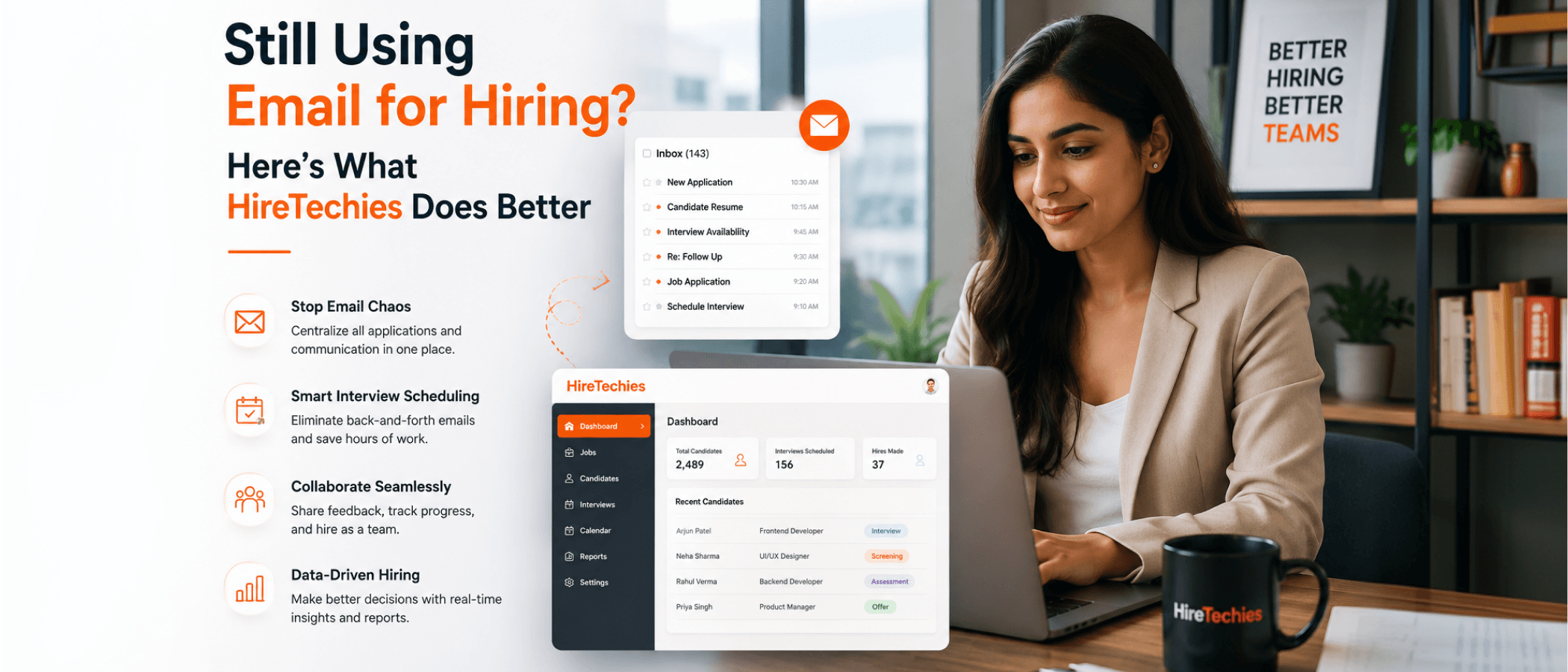
Still Using Email for Hiring? Here’s What HireTechies Does Better
GuidanceHiring used to be simple. You posted a job, a few people applied, you read their CVs, called the ones you liked, and made a decision. The whole thing fit inside an inbox without much trouble. That was a long time ago.
Today, a single job post can bring in hundreds of applications within days. And if you are still managing all of that through email, sorting, replying, following up, and scheduling, you already know how quickly it falls apart. Things get missed. Good candidates wait too long. Someone perfect for the role quietly accepts an offer somewhere else while your email thread is still sitting unread. This is not a small problem. It is how companies lose good people without ever realising it.
The Email Hiring Problem Nobody Talks About Honestly
Most recruiters do not admit this out loud, but managing hiring through email is exhausting in a way that sneaks up on you. It starts fine. A few applications come in, you respond, you keep track. But the moment volume picks up, everything starts to blur.
You have CVs in your inbox, some forwarded to your manager, some downloaded to a folder on your desktop, and a few more sitting in a WhatsApp chat because someone sent them there instead. Now try telling me which candidate is at which stage. Try remembering who you promised to follow up with by Thursday.
The Inbox Becomes a Black Hole
Here is what actually happens. A candidate applies. The email gets buried under twenty other things. By the time someone finds it, four days have passed. The candidate, assuming they heard nothing, has already moved on. Email was never designed for this. It is a communication tool, not a hiring tool. Using it to manage recruitment is like using a notepad to run a project with fifteen moving parts. It works until it does not.
Following Up Becomes a Full-Time Job
Scheduling an interview over email can take five or six messages back and forth. Availability does not match. Someone does not reply. You send a reminder. They reply with new times. You go back to the hiring manager. By the time a slot is confirmed, three days have passed, and the energy around the whole thing has gone flat. Multiply that by twenty candidates, and you will understand why so many recruiters feel like they spend more time managing emails than actually hiring.
Why Manual Recruitment Gets Harder as You Grow
Small teams can sometimes get away with email hiring, at least for a while. But the moment your hiring picks up, more roles, more candidates, more people involved in the decision, manual processes start breaking down fast. The problem is not effort. Recruiters work hard. The problem is that there is no structure holding everything together. Notes live in different places. Feedback from interviewers comes through scattered messages. No one has a clear picture of where each candidate stands.
Good Candidates Do Not Wait Around
Here is the truth about hiring in a competitive market. Candidates who are actually good at what they do have options. They are talking to more than one company. If your process is slow, unclear, or feels disorganised from their side, they will simply go with whoever moves faster and communicates better. A slow email process does not just frustrate your team. It costs you, candidates you actually wanted.
What a Proper Hiring System Actually Changes
When recruiters move away from email-based hiring and into a proper system, the first thing they notice is not speed. It is clarity. Everyone on the team can see the same information on where each candidate is in the process. What feedback has been given, and what is the next step? Nobody has to chase anyone for an update because it's already there.
Resumes Stop Getting Lost
When all applications come into one place, nothing slips through. Every CV is logged, visible, and attached to a profile that follows the candidate through every stage. You can filter by skills, experience, or role without scrolling through an inbox looking for an attachment from two weeks ago.
Scheduling Stops Being a Negotiation
A good hiring tool lets candidates pick their own interview slot based on actual availability. No back and forth. No five email threads. The interview gets booked, both sides get a confirmation, and everyone moves on. It sounds like a small thing until you calculate how much time it actually saves across an entire hiring cycle.
What HireTechies Does Differently
There are a few applicant tracking systems out there. Most of them were built for large enterprise companies with big HR teams and even bigger budgets. They are powerful but complicated, and they come with a learning curve that smaller teams simply do not have time for. HireTechies was built with a different kind of recruiter in mind. Someone who is managing multiple roles, possibly without a large team behind them, and who needs something that actually works without requiring a week of training to figure out.
Everything in One Place
Applications come in and land in a single dashboard. You can see every candidate, every role, every stage at a glance. There is no switching between tabs, no hunting through email folders, no spreadsheet running alongside everything else just to keep track.
The Communication Does Not Fall Apart
One of the quieter problems with email hiring is that candidate communication becomes inconsistent. Some people get fast replies. Others wait days for a response. With HireTechies, follow-ups and status updates go out without the recruiter having to manually write and send each one. The candidate always knows where they stand, which matters more than most hiring teams realise.
The Team Stays on the Same Page
Hiring decisions rarely happen alone. Someone screens, someone interviews, someone from the team gives input, and a manager makes the final call. When all of that conversation happens across emails and chat messages, things get confused. Feedback gets lost. Opinions contradict each other because nobody was looking at the same information. HireTechies keeps all of that in one thread attached to the candidate. The hiring manager sees what the interviewer said. The recruiter sees what the team thinks. Nobody has to ask twice.
Why Recruiters Are Moving On From Email
It is not that email is bad. It is that the email was never designed for what recruiters are trying to do with it. It is a tool being used outside its purpose, and the cracks show up exactly when the pressure is highest, when you are hiring fast, when multiple roles are open at once, when the team is stretched, and decisions need to happen quickly. The recruiters who make the switch to something like HireTechies are not doing it because it is trendy. They are doing it because they got tired of losing good people to a slow, scattered process. They got tired of spending hours on things that should take minutes.
A Simpler Way to Hire
Hiring will never be completely easy. Finding the right person for a role takes judgment, time, and genuine attention. No tool replaces that. But the administrative side of hiring, the tracking, the scheduling, the follow-ups, the keeping everyone informed, that part does not need to be hard. It does not need to live inside an inbox that was never built for it. That is why recruiters are moving away from email. And that is exactly why HireTechies exists. Good hiring starts with a process that actually supports you. Everything else follows from there.