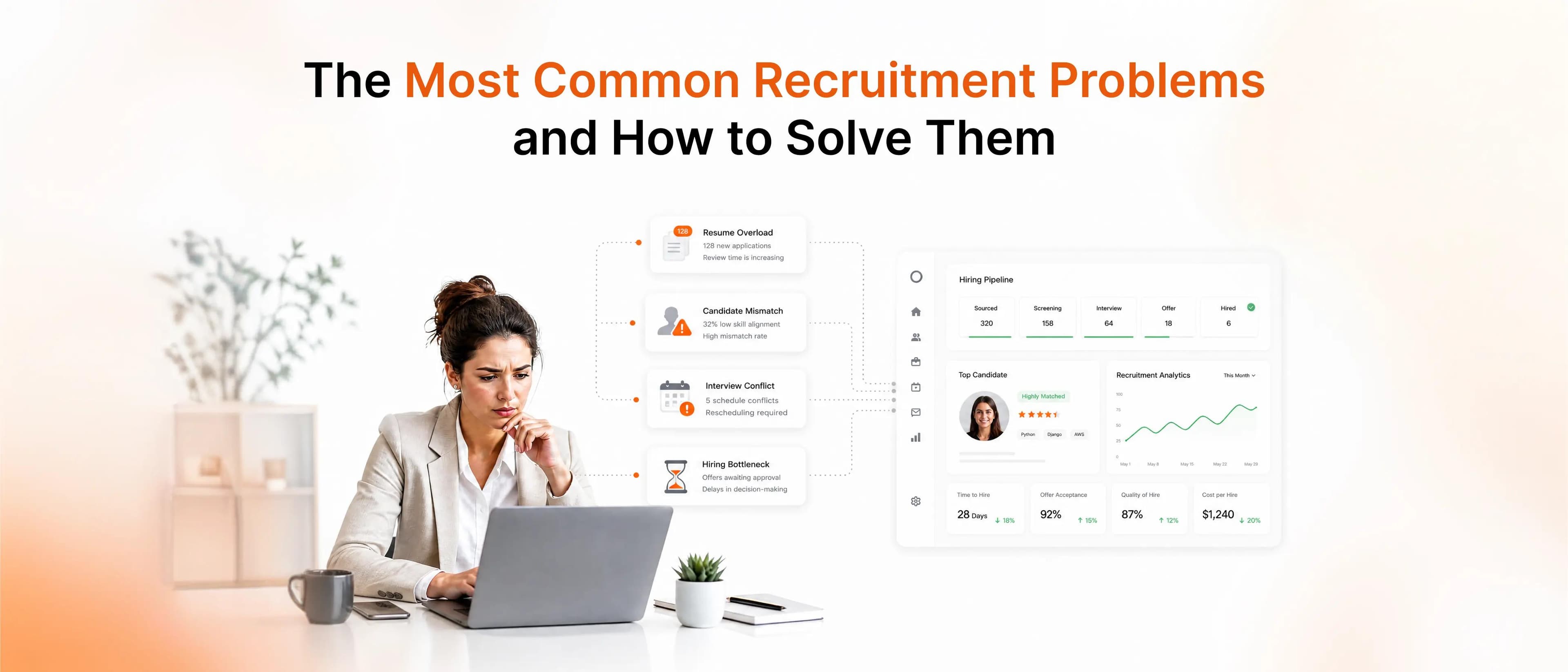
The Most Common Recruitment Problems and How to Solve Them
GuidanceAsk any HR manager how hiring is going right now, and you'll probably get a tired laugh before an actual answer. Finding good people has never been easy, but somehow it keeps getting harder, even with more tools and more applicants than ever before. Post a job today, and your inbox fills up within hours. That sounds great on paper. In reality, most of those resumes don't match what you actually need, and the good ones get buried somewhere on page four of your ATS.
Meanwhile, the clock is ticking. Hiring managers are stuck doing admin work instead of interviewing. Candidates you actually wanted end up taking a job somewhere else because your process moved too slowly. None of this is a sign that your company is doing something uniquely wrong. These are the same eight problems most growing teams run into. Below is what they actually look like, why they happen, and what tends to fix them.
What Counts as a Recruitment Challenge Really
A recruitment challenge is basically anything that gets in the way of finding and hiring the right person without wasting weeks doing it. It could show up at any stage, from a badly written job post to an offer letter that sits in someone's inbox for five days.
Left alone, these problems compound. Roles stay open longer than they should, the existing team picks up the slack and starts to burn out, and cost per hire quietly climbs. Fixing this stuff starts with actually naming what's going wrong.
1. Too Many Unqualified Applicants
You put up a job, and within a day you have 300 applications. Maybe 20 of them are even close to qualified. This happens because most job boards let people apply in one click. Nobody reads the requirements carefully anymore; they just hit apply and move on to the next listing.
The fix isn't complicated; it just takes discipline. Write job descriptions that spell out exactly what's non-negotiable, not a wishlist of nice-to-haves. Then let automated resume screening do the sorting for you instead of a person scrolling through hundreds of PDFs. HireTechies, which is free to use, parses incoming resumes and surfaces the ones actually worth your time.
2. Hiring Takes Too Long
Weeks pass. Sometimes months. By the time you're ready to make an offer, the candidate you wanted has already signed somewhere else. Usually the delay isn't one big thing; it's a pile of small ones. Feedback from interviewers takes days to come back. Scheduling an interview means five emails going back and forth. Approvals sit with someone who's travelling. Look at your funnel and cut what doesn't need to be there. Set a real deadline for interview feedback, not a suggestion. Automating scheduling and status emails alone can shave real time off your process.
3. Candidates Feel Ignored
Candidates apply and then hear nothing. No confirmation, no rejection, nothing. It's one of the most common complaints job seekers have, and it does real damage to how people see your company. It's not usually intentional. Recruiters are stretched thin and personal follow-ups fall to the bottom of the list.
Automated updates at each stage solve most of this. It doesn't need to be a personal essay, just a simple note that says someone's application was received, or that they moved to the next round. A decent ATS handles this without anyone lifting a finger.
4. Specialised Roles Sit Open for Months
Some roles just don't get applicants. Not because the job is bad, but because the people who could actually do it well aren't out there scrolling job boards. The strongest candidates for niche or technical roles are usually already employed and not actively looking. You won't find them by posting and waiting. This means sourcing directly instead of waiting around. Build a pipeline of passive candidates over time, reach out personally, and stay in touch even when there's no open role yet. When the right position finally opens, you're not starting from zero.
5. Bias Creeps Into Evaluations
Even well-intentioned hiring teams end up favouring candidates who feel familiar, whether that's a shared alma mater or a resume that just looks a certain way. It's rarely deliberate, but it happens constantly. Gut instinct and unstructured interviews are usually the culprit. Different interviewers ask different questions and score answers based on vibe rather than substance.
Structured interviews fix a lot of this. Ask every candidate the same set of job-related questions and score them against a fixed rubric. Some AI hiring tools can also anonymise resumes, hiding names and photos so the first impression is based on skills alone.
6. Teams Aren't on the Same Page
Recruiters and hiring managers disagree on what the role actually needs. Interview notes live in someone's inbox instead of a shared doc. Approvals get delayed because nobody knows who's supposed to sign off. The root cause is almost always fragmentation. Everyone's using a different tool, or no tool at all, and information just doesn't flow. Bring it all into one place. HireTechies keeps scorecards, notes and feedback in a single dashboard so nobody's chasing down information across five different threads.
7. Cost Per Hire Keeps Climbing
Agency fees, premium job listings, weeks of lost productivity while a seat sits empty. It adds up fast, and most of it comes from working around inefficiency rather than fixing it. Manual processes are expensive in ways that don't always show up on a spreadsheet line item. Every extra day a role stays open costs money, even if nobody's tracking it that way. A free ATS like HireTechies gives smaller teams the same screening and tracking power as companies with much bigger budgets, without the subscription cost or the agency fees.
8. No Real Data on What's Working
Ask most companies where candidates drop off in their pipeline, and you'll get a shrug. The data exists somewhere, usually scattered across spreadsheets nobody updates. Without tracking, you're guessing. You don't know which job boards actually bring in hires, or where good candidates lose interest and disappear. A built-in analytics dashboard tracking time-to-hire, offer acceptance, and drop-off points turns guesswork into something you can actually act on.
Why More Companies Are Leaning on AI for Hiring
Recruiting has always needed speed and consistency, and honestly, most teams are stretched too thin to deliver both manually. AI tools handle the repetitive parts, freeing recruiters up to do the part that actually needs a human, which is talking to people.
Compare the two approaches, and the difference is obvious. Manual resume review can eat hours of a recruiter's day, while automated screening does it in seconds. Scheduling that used to mean endless email threads becomes self-service. Notes scattered across spreadsheets become one shared dashboard. And decisions that used to lean on gut feeling get backed by actual data. None of this replaces recruiters. It just removes the parts of the job that were never a good use of their time in the first place.
Why HireTechies
HireTechies was built around one idea: solving these problems shouldn't require a big budget or a complicated setup. Zero cost to get started. It's a genuinely free AI applicant tracking tool built for teams that are growing but don't have enterprise software budgets.
Resume screening that actually ranks candidates against what the role needs, so you're not the one deciding who to look at first.
One dashboard for the whole team, keeping notes, ratings and communication in a place everyone can see. Automation that carries a candidate from application through to onboarding without someone manually pushing them along at every step.
Key Takeaways
Automate the early screening so volume stops being a problem. Fix scheduling delays before they cost you a candidate. Standardise interviews so evaluations come down to skill, not gut feel. Keep everything in one platform so your team stops working in silos.
Wrapping Up
None of these problems fixes themselves. But once you can actually name what's slowing your hiring down, fixing it stops being overwhelming and starts being a checklist. If you're ready to stop losing candidates to slow processes and scattered spreadsheets, HireTechies is free to try and built for exactly this.