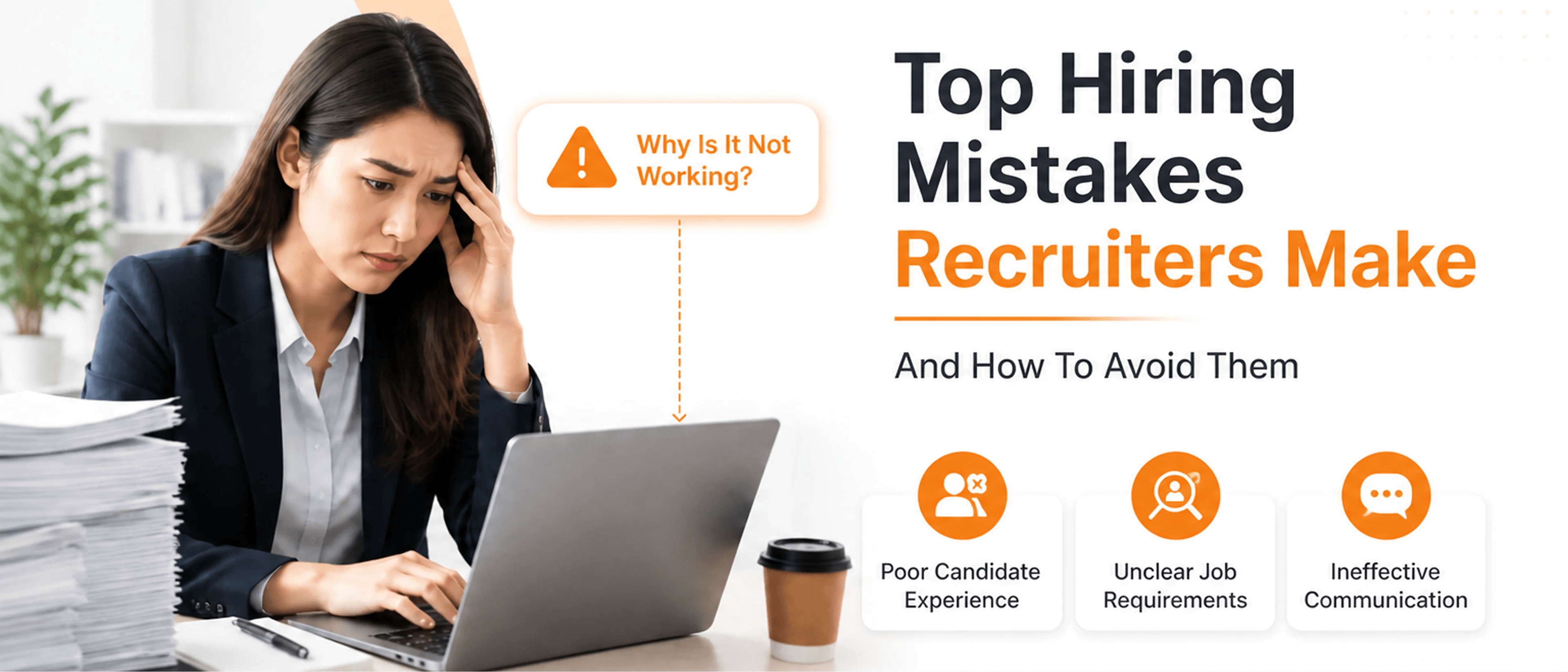
Top Hiring Mistakes Recruiters Make and How to Avoid Them
GuidanceLet’s be honest: recruitment has never been easy, but lately, it feels like we are playing on hard mode. Between shifting candidate expectations, the rapid rise of tech stacks, and the constant pressure to fill roles yesterday, recruiters are stretched incredibly thin.
We’ve all been there, flooded with hundreds of resumes for a single IT role, chasing down hiring managers for feedback, or losing a stellar software engineer to a competitor because our offer loop took a few days too long. In the rush to meet performance targets, even the most experienced talent acquisition professionals fall into traps that cost time, money, and top-tier talent.
Identifying these pitfalls isn't about pointing fingers; it's about building a smoother, more human hiring workflow that actually works. Let’s break down the most common hiring mistakes recruiters make and how to fix them before they drain your resources.
Why Hiring Mistakes Are More Expensive Than Ever
A bad hire or a broken recruitment process isn't just a minor bump in the road anymore; it's a major financial drain. Industry data from organisations like the Society for Human Resource Management (SHRM) consistently shows that the cost-per-hire is a significant investment, but the true cost of a mistaken hire can be multiple times that employee’s annual salary. In tech and IT sectors, the stakes are even higher. When you factor in the cost of broken code, disrupted sprint cycles, lost productivity, and the inevitable exit interview, a single hiring mistake can easily cost a company tens of thousands of dollars. Beyond the spreadsheet, a clunky recruitment process damages your employer brand. Candidates talk, and in the age of Glassdoor and social media, a poor interview experience can deter top talent from ever applying to your company again.
Top Hiring Mistakes Recruiters Make
Writing Unclear or Generic Job Descriptions
Too many job descriptions look like a massive wish list of disconnected skills. When an IT company asks for a developer with decades of experience in a framework that only came out a few years ago, candidates roll their eyes and click away.
- Why it happens: Recruiters often copy-paste old templates or simply write down everything a hiring manager throws at them without filtering.
- The Impact: You either get zero applications or a flood of completely irrelevant resumes from candidates guessing what you actually want.
- The Fix: Focus on outcomes rather than a checklist of skills. Write down what the person will actually accomplish in their first six months.
Relying Only on Manual Resume Screening
If you are still opening every single document line-by-line to find keywords, you are burning valuable hours.
- Why it happens: A lingering belief that manual screening is the only way to maintain a personal touch, or simply a lack of modern tools.
- The Impact: Human fatigue sets in after reading dozens of resumes. You risk missing a great candidate buried deep in the stack simply because your eyes glazed over.
- The Fix: Implement reliable Applicant Tracking Software to handle the heavy lifting. Let technology surface the best matches so you can spend your energy talking to people, not reading papers.
Ghosting and Slow Candidate Communication
We hate it when candidates ghost us, but let's be fair: recruiters are often just as guilty. Leaving candidates in the dark for weeks is the fastest way to kill your employer brand.
- Why it happens: Recruiters get overwhelmed by volume and lack the time to send manual updates to hundreds of applicants.
- The Impact: Industry research from LinkedIn reveals that a vast majority of candidates lose interest in a job if the hiring process takes too long or lacks communication. They will accept other offers.
- The Fix: Set up automated, conditional email updates. Even a simple confirmation that you are still reviewing applications keeps candidates engaged.
Delaying Interview Scheduling
The endless back-and-forth email thread to find a single open window where the candidate and multiple internal interviewers are all free is a massive bottleneck.
- Why it happens: Relying on manual calendar checking and dealing with busy hiring managers who don't open their schedules.
- The Impact: By the time you finally lock in a date, a faster, more agile competitor has already conducted multiple interviews with your star candidate.
- The Fix: Use automated scheduling links that sync directly with your team's calendars, allowing candidates to pick a time that works instantly.
Providing a Poor Candidate Experience
A rigid, frustrating application form that forces candidates to upload a resume and then re-type their entire employment history into tiny text boxes is a recipe for high drop-off rates.
- Why it happens: Outdated legacy systems designed for compliance rather than user experience.
- The Impact: High-quality talent, especially passive candidates who are just testing the waters, will abandon the application mid-way.
- The Fix: Keep the initial application incredibly brief. Respect their time and make the mobile application experience seamless.
Losing Track of Applicants
When your hiring pipeline consists of spreadsheets, sticky notes, and flagged emails, candidates inevitably fall through the cracks.
- Why it happens: Managing multiple open roles across different departments without a centralised dashboard.
- The Impact: You forget to follow up with an excellent candidate, or worse, you accidentally invite the same person for the same interview twice. It looks highly unprofessional.
- The Fix: Centralise your talent pipeline. Every candidate should move through clear, visual stages like Applied, Screened, Interviewed, and Offered in a single system.
Not Collaborating with Hiring Managers
Recruitment isn't a solo sport. When recruiters and hiring managers work in silos, the entire process breaks down.
- Why it happens: Lack of a shared platform for feedback, leading to scattered chat messages, loose emails, and forgotten verbal comments.
- The Impact: You pass along candidates you think are perfect, only for the hiring manager to reject them instantly because the actual requirements changed.
- The Fix: Use a system where hiring managers can leave scorecards, notes, and ratings directly on the candidate’s profile.
Hiring Based Only on Resumes
Resumes show history, but they don't show real-world capability, problem-solving skills, or cultural alignment.
- Why it happens: It’s the easiest, most traditional metric available to filter people quickly.
- The Impact: You hire someone who looks brilliant on paper but struggles to work within your team structure or lacks practical execution skills.
- The Fix: Introduce short, practical assessments or structured behavioural interviews early in the process to evaluate actual competency.
Ignoring Recruitment Analytics
If you don't know your average time-to-hire, your drop-off points, or where your best candidates are coming from, you are recruiting in the dark.
- Why it happens: Teams are often too focused on immediate fires to analyse long-term data trends.
- The Impact: You continue spending money on channels that yield poor results while ignoring the sources that actually bring in top performers.
- The Fix: Track core metrics like source of hire, time-to-hire, and offer acceptance rates using built-in analytics dashboards.
Taking Too Long to Make the Final Decision
Waiting for the perfect mythical candidate who ticks every single box often means losing out on great candidates who tick most of them and learn quickly.
- Why it happens: Fear of making a bad hire leads to analysis paralysis and endless internal debates.
- The Impact: Reports from Glassdoor show that lengthy interview processes cause top talent to lose momentum and opt out, leaving you right back at square one.
- The Fix: Establish a strict timeline for post-interview feedback and stick to a firm decision deadline shortly after the final round.
How Modern Applicant Tracking Software Helps Recruiters
To avoid these mistakes without burning out, you have to change how you work. You cannot solve modern hiring volume issues with manual effort alone. This is exactly where modern Applicant Tracking Software steps in.
Instead of acting as a passive digital filing cabinet, modern recruitment tech acts as an active assistant. It automates repetitive administrative tasks like sending follow-up emails, parsing resumes, and structuring calendars so that recruiters can focus on what they do best: building relationships with candidates and evaluating cultural fit.
How HireTechies Helps Recruiters Avoid These Hiring Mistakes
If you are looking for a way to streamline this entire ecosystem without adding financial strain to your department, HireTechies offers a highly practical, modern solution. Built specifically to tackle the unique bottlenecks faced by fast-growing teams, HireTechies serves as a robust Free AI Applicant Tracking Software (ATS) for IT Companies and tech-focused startups.
Here is how it directly solves the hiring mistakes we just discussed:
- AI-Powered Resume Screening and Matching: Instead of spending days sorting through hundreds of IT profiles, the platform uses AI candidate matching to instantly surface the resumes that best fit your technical requirements.
- Seamless Candidate Management and Workflow Automation: It visualises your pipeline clearly, ensuring no applicant is ever lost or left without a status update.
- Built-In Interview Scheduling and Calendar Integration: It eliminates email ping-pong by syncing with your calendars, allowing candidates to pick their own interview slots smoothly.
- Deep Team Collaboration: Hiring managers and recruiters can view candidate profiles simultaneously, leave interview scorecards, and align on decisions in real-time.
- AI-Generated Interview Questions: Never walk into an interview unprepared. The platform can generate tailored, role-specific technical questions based directly on the candidate's background.
- Clear Reporting and Analytics: Built-in tracking gives you a bird's-eye view of your hiring bottlenecks, helping you optimise your time-to-hire effortlessly.
By offloading the administrative weight to HireTechies, your talent acquisition team can stop chasing paperwork and start focusing on human engagement.
Best Practices for Smarter Hiring in 2026
- Audit Your Pipeline Regularly: Take an afternoon to apply to your own open roles. See firsthand where the application friction lies.
- Define Must-Haves vs. Nice-to-Haves: Align with your hiring managers before a job goes live to prevent moving goalposts later.
- Treat Candidates Like Customers: A transparent, respectful, and communicative interview loop creates brand advocates, even among those you don't end up hiring.
- Leverage Free, High-Quality Tech: You don't need a massive enterprise budget to use great software. Leverage agile platforms to level the playing field.
Conclusion
Recruiting will always have its challenges, but many of the biggest bottlenecks we face are entirely within our control. By cleaning up job descriptions, committing to clear and fast communication, and collaborating tightly with hiring managers, we can drastically improve our hiring outcomes.
You don't have to overhaul your entire department overnight. Start by identifying the single biggest friction point in your current workflow, whether that's scheduling delays or messy resume screening, and address it. Utilising modern platforms like HireTechies alongside these structured best practices can help you build a hiring machine that is fast, data-driven, and thoroughly human.