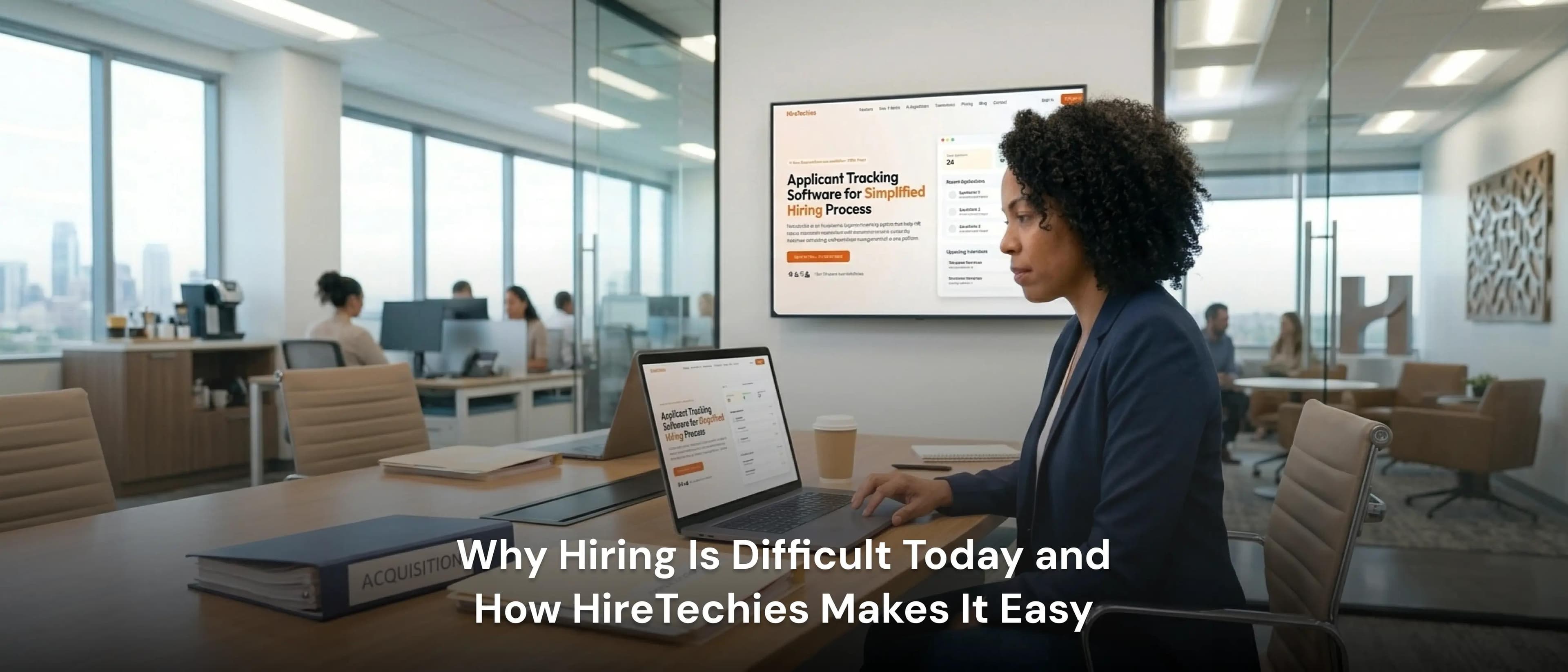
Why Hiring Is Difficult Today and How HireTechies Makes It Easy
RecruitmentHiring the right people is one of the most important things a company can do. It can also be one of the most frustrating. For start-ups and growing tech companies, the process often takes longer than expected, costs more than planned, and still doesn't guarantee the right outcome.
The good news is that these hiring challenges aren't unsolvable. With the right approach and the right platform, companies can hire faster, smarter, and without the financial pressure that traditional recruitment puts on them.
Why hiring is difficult today
The hiring landscape has changed dramatically. Job boards are flooded. Candidates are overwhelmed with options. Companies are competing for the same limited pool of skilled professionals.
At the same time, remote work has expanded the talent market globally, which sounds like good news, but it also means more competition, more applicants, and more complexity in the screening process.
For start-ups, especially, there's no dedicated HR team managing this. The founder or a senior team member takes it on, pulling time and focus away from building the product and serving customers.
Common hiring challenges companies face
Too much time spent on hiring
A single open role can take weeks, sometimes months, to fill. Posting jobs, reviewing applications, scheduling calls, running interviews, and making offers each step eats into the working day.
For a team of five, losing a founder's attention for two months is no small matter. It slows decisions, delays product work, and creates pressure across the whole business.
Too many irrelevant applications
Posting on a general job board often means receiving hundreds of applications, most of which don't match the role. Sorting through them manually is time-consuming and demoralising.
The more unqualified applicants there are, the harder it becomes to find the ones worth speaking to and the easier it is to overlook a strong candidate buried in a crowded inbox.
Difficulty evaluating candidates
Knowing who is actually skilled versus who presents well on paper is genuinely hard. Resumes often look similar. Interview performance doesn't always reflect real-world ability. Without a structured evaluation process, companies either over-rely on gut feeling or build lengthy test processes that put good candidates off entirely.
The hidden cost of hiring
Most companies focus on the obvious cost of hiring: the recruiter's fee, the job board subscription, and the hours spent in interviews. But there's a less visible cost that's just as significant. Every week a role stays open is a week the team is stretched thin. Projects take longer. Priorities get dropped. The people covering the gap work harder and burn out faster.
For early-stage companies, that kind of outlay isn't just expensive, it's often impossible. And even when it is affordable, it shifts money away from the product, the team, and the customers the company actually exists to serve. Delayed hiring and expensive hiring both carry a cost. The solution isn't to choose between them, it's to find a better option.
Why tech hiring is even more difficult
Hiring for technical roles adds a layer of difficulty that general hiring simply doesn't have. If the person making hiring decisions isn't a developer themselves, evaluating candidates becomes genuinely hard. Everyone claims experience with every technology. Resumes blur together. It's difficult to know what questions to ask, what answers to trust, or what a realistic skills benchmark actually looks like.
Skilled developers are also rarely available and in short supply. They're already employed, generally comfortable, and only open to something new if it comes along at the right moment, framed the right way.
Reaching them through generalist platforms where they aren't paying attention is unreliable. Reaching them through recruiters is expensive. Building a strong enough employer brand to attract them passively takes years.
This is the reality that hiring challenges in tech are built on. And it's why a general-purpose hiring solution rarely delivers the results tech companies need.
How HireTechies makes hiring easier
HireTechies is a hiring platform built specifically for tech roles, free to use for both companies and candidates. There are no placement fees. No subscriptions required to access the candidates you actually want. No middlemen taking a percentage of transactions that don't need them. Just a direct connection between companies that are hiring and tech professionals who are genuinely looking.
The platform is designed around the specific reality of technical hiring. The candidate profiles, search filters, and skill categories are built with tech roles in mind, not adapted from a generalist template designed to serve every industry at once.
That focus matters. A platform where developers, designers, and product professionals are actively present because it was built for them is a fundamentally different environment from one where they're a small subset of a much larger, noisier pool.
Benefits of using HireTechies
- No cost to hire - Post roles and connect with candidates without paying a placement fee or subscription. This removes the financial barrier that makes traditional recruitment inaccessible for many start-ups.
- Built for tech roles only -The platform is not trying to serve every industry. It focuses on software, product, and design roles, which means higher-quality candidates and more relevant results.
- Better signal, less noise - Candidates on the platform are specifically looking for tech opportunities. That intentionality on both sides makes the process faster and less exhausting.
- Respects the candidate experience - Developers and designers are selective about where they look. A platform that treats them well attracts better people, and that directly improves which companies can hire.
- Simple to get started - There's no lengthy onboarding process, no contracts to sign, and no setup fee. Companies can post a role and start seeing candidates without any friction.