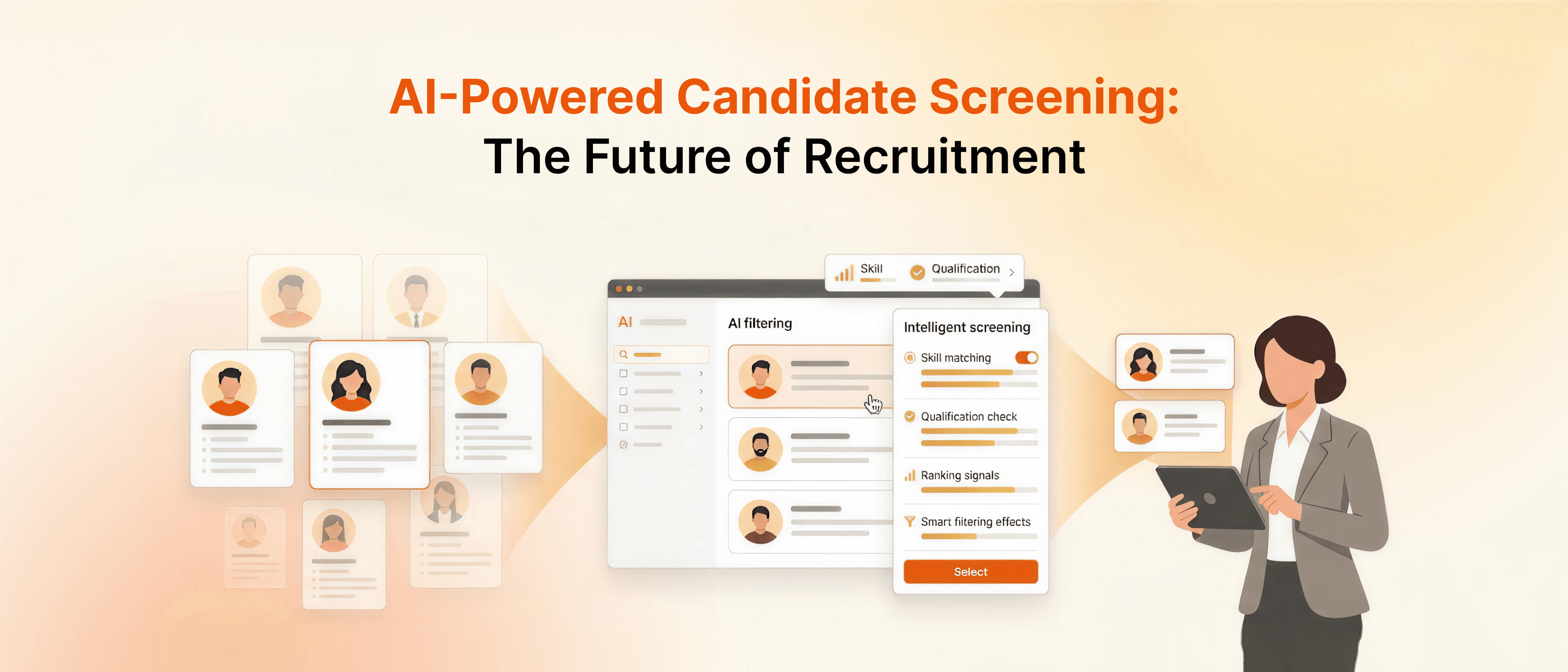
AI-Powered Candidate Screening: The Future of Recruitment
AI & TechnologyHiring the right person has never been easy. And if you've been part of a recruitment team in the last few years, you already know how overwhelming it gets. Hundreds of applications coming in for a single role, endless follow-up emails, scheduling headaches, and somehow still ending up with the wrong hire.
The good news is that AI recruitment tools are genuinely starting to fix this, not in some sci-fi robots-taking-over way, but in a practical, day-to-day way that makes life easier for recruiters and leads to better hiring decisions. AI-powered candidate screening is becoming a core part of how modern teams hire, and companies that still rely on fully manual processes are starting to feel the gap.
The Real Cost of Traditional Candidate Screening
Let's be honest. The old way of screening candidates is exhausting and often unfair to everyone involved. A recruiter posts a job, and within 48 hours, 300 applications are sitting in the inbox. Each one needs to be opened, read, evaluated, and sorted. Most of it is repetitive work: checking for basic qualifications, filtering out roles that don't match, comparing candidates who all look similar on paper.
This process typically eats up anywhere from 20 to 40 hours per open role. That's time that could be spent on actual recruiting, talking to people, building relationships, and working on the candidate experience.
And there's another problem nobody talks about enough. Humans are inconsistent. When a recruiter is going through their 80th resume on a Friday afternoon, their judgment is not the same as on Monday morning. Important details get missed. Good candidates get overlooked simply because of timing. Manual screening also slows everything down. The best candidates don't sit around waiting. If your process takes three weeks just to build a shortlist, you are already losing people to faster-moving competitors.
Why AI-Powered Candidate Screening Actually Works
AI does not get tired. It does not have off days. It can process 500 applications with the same level of attention it gave to the first one. But speed is only part of it. The bigger value is consistency and accuracy.
Faster Hiring Without Cutting Corners
When AI handles the early screening work like parsing resumes, scoring candidates against the role requirements, and flagging strong matches, recruiters can spend their time where it actually matters. Time-to-hire drops significantly, sometimes by more than half.
For start-ups and growing companies where every unfilled seat has a real cost, speed matters a lot. It matters just as much for larger HR teams juggling 20 open roles at the same time.
Better Talent Matching
Modern smart hiring software does not just scan for keyword matches. It can look at skills, career trajectory, the kinds of roles someone has excelled in before, and how that maps to what you actually need. The result is a shortlist of candidates who genuinely fit the role, not just the ones who happened to format their resume the right way.
Reduced Hiring Bias
This one deserves more attention than it usually gets. Unconscious bias in hiring is real, and it costs companies good talent they never even got to see.
AI-powered screening, when designed responsibly, evaluates people based on qualifications and relevant experience rather than factors that should not matter. It creates a more consistent process, especially at the top of the funnel where bias tends to show up most.
It is not a perfect solution. The data behind any AI system still matters. But structured, criteria-based screening tends to be far more consistent than a purely manual review done by different people on different days.
Improved Recruiter Productivity
When recruiters are not buried in resume stacks, they can do more of what they are actually good at: interviewing candidates, assessing culture fit, negotiating offers, and making sure people have a good experience throughout the process. Automated candidate screening does not replace the human side of hiring. It gives that human side more room to breathe.
Real Hiring Challenges That AI Helps Solve
If you have managed recruitment at any scale, these situations will feel familiar. High application volumes hit teams hard when a job post gets shared widely or goes out during peak hiring season. A three-person team suddenly has 600 applications and a deadline three weeks out. There is no clean manual solution to that problem.
Inconsistent evaluation is another one. Different recruiters assess candidates differently. When there is no clear rubric and the criteria shift based on who is doing the screening that day, the process becomes unreliable and hard to defend.
Long time-to-hire is expensive in ways people underestimate. You finally identify a strong candidate after a drawn-out process, and they have already accepted another offer. It happens more than most companies admit.
Candidate tracking also breaks down at scale. Without proper tooling, follow-ups get missed, people get stuck in limbo between stages, feedback never gets recorded, and eventually someone good just stops responding. These are not edge cases. They are the everyday reality for most HR teams, and they compound over time.
How Platforms Like HireTechies Fit Into This
This is where purpose-built recruitment automation platforms make a real difference. HireTechies is designed specifically around these pain points. Its AI-powered applicant tracking system helps HR teams automate the early stages of screening, so instead of manually sorting through hundreds of applications, recruiters get a smart-ranked shortlist based on the criteria they actually care about.
Beyond screening, HireTechies brings together interview scheduling, workflow automation, and candidate management into one connected system. That means less jumping between tools, less manual coordination, and fewer things falling through the cracks during a busy hiring push.
For growing teams, especially, having that structure in place early makes a real difference to hiring quality and speed. It is not about replacing the human judgment that good hiring requires. It is about making sure that judgment gets applied at the right moments.
The Future of AI in Recruitment
We are still in the early stages of what AI can actually do here. But the direction is clear. Predictive hiring analytics will become more common. AI will increasingly help teams understand not just whether someone can do a job, but how likely they are to stay, grow into a role, and perform well in a specific work environment.
Conversational AI for candidate engagement is already showing up in forward-looking companies. Smart chatbots that handle initial screening questions, answer common candidate queries, and keep applicants informed without adding to a recruiter's workload.
Skills-based hiring is also getting a serious boost from AI. Companies are getting better at finding candidates who can actually do the work, even when their resume does not follow a conventional path. That opens up talent pools that manual screening would have closed off.
The overall picture is a hiring process that is more data-informed, faster on the admin side, and more human where it needs to be, because the tools are handling the parts that do not need a person's attention.
Conclusion
Hiring has always been one of the most consequential things a company does. But for a long time, the process has worked against the people trying to do it well. Slow, manual, inconsistent, and easy to get wrong. AI-powered candidate screening is changing that in practical ways, not theoretical ones. It is not about taking humans out of hiring. It is about giving your team better tools so the humans in the process can actually do their best work.
If your current recruitment setup feels like it is creating problems rather than solving them, it is worth taking a proper look at what recruitment automation can do for you. HireTechies is a good place to start that conversation. The right platform, used well, can change not just how fast you hire but the quality of who you bring in.